
SAB Society Wales
SAB Society Wales
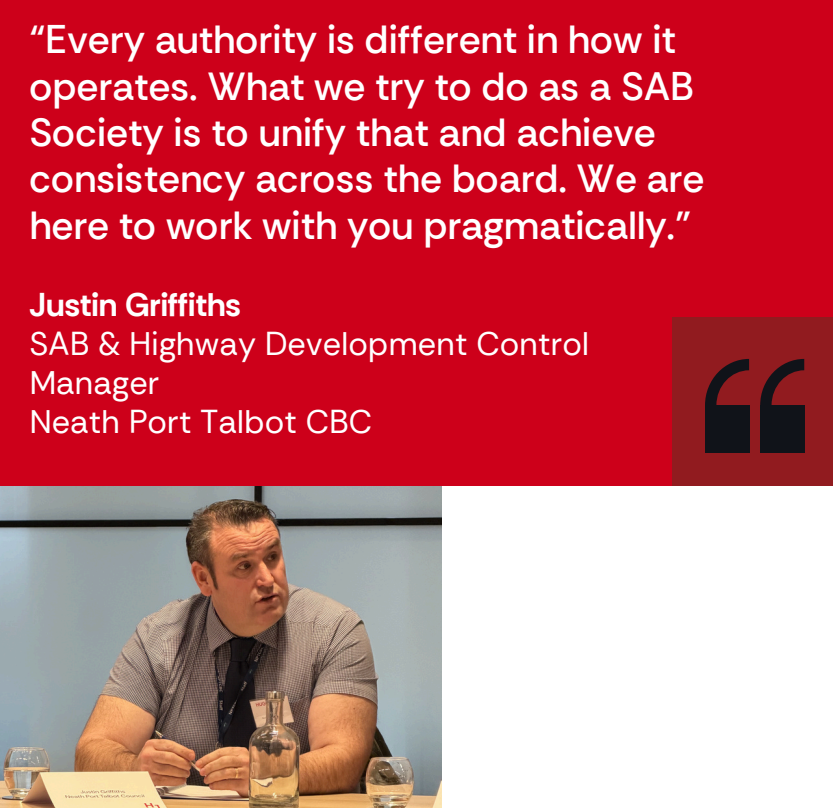
Following on from the creation of SAB Society Wales on 7th January 2026, members of our Executive Board were invited to join a roundtable convened by Hugh James and involving Welsh Government, the Welsh Local Government Association, the Royal Town Planning Institute, Welsh Water, private developers, housing associations, planners and consultants to discuss “Unlocking SuDS delivery”.
Celebrating Successes
The panel agreed that the implementation of Schedule 3 of the Flood and Water Management Act 2010 has placed Wales in a unique position by establishing statutory SuDS approval and adoption.
Compared to the non-statutory legislative approaches in other parts of the UK, all parties agreed that Wales is achieving better outcomes to address long-standing issues of flood risk, pollution and, crucially, long-term stewardship of SuDS.
Over 7,500 new developments and re-developments have gone through SAB approval since the implementation of Schedule 3 in January 2019. This provides a solid foundation of knowledge and experience not only in the design and construction of SuDS but also in navigation through the regulatory processes both within SABs and across the wider sector. Evaluation of applications shows that 85% of outflows do not use combined sewers or highway drains as the outfall from the developments and that 60% of applications are on brownfield sites, which would traditionally have been reliant on aging sewer infrastructure. This shows that SuDS are effectively diverting water away from combined sewers, reducing the pressure on these systems and helping to reduce sewer flooding and discharges from combined sewer overflows.
Acknowledging Challenges
Participants recognised that challenges remain in relation to SuDS delivery in Wales but were clear that the objective now should be to improve delivery and not to dilute standards.
Key themes were identified around
The emergence of SAB Society Wales was widely welcomed as a positive, practical step towards shared principles and greater transparency that will help to accelerate progress towards tackling the challenges and sharing best practice.
Recommendations and Next Steps
Several recommendations came out of the roundtable, and these are presented in a whitepaper report from Hugh James.
Progress is already being made on delivery of the recommendations in the following areas:
Welsh Government have published updated Statutory Guidance, put together with the support of SAB Society Wales and other members of Welsh Government’s SuDS Community of Practice.
SAB Society Wales members are also on the steering committee for the Rainwater Management Platform that will transform the classic SuDS Manual (C753) into an innovative, multi-functional, user-focused online platform.
SAB Society Wales have met with the Home Builders Federation and are developing a list of Do’s and Don’ts for both applicants and SABs. alike These will highlight some of the key common pitfalls around applications and how these can be avoided and will be published on the SAB Society Wales website.
SAB Society Wales are developing a Statement of Common Principles in relation to Commuted Sums. This will set out the background and methodology for Commuted Sum calculations across Wales and confirms key parameters, such as discount rates and assessment time, whilst still allowing flexibility for local factors to be taken into account and will be published on the SAB Society Wales website.
The Hugh James whitepaper includes a statement that there is no appeal mechanism for SAB decisions. SAB Society Wales would like to highlight that there is a statutory appeal process, which is very similar to that used for Planning permission. The appeal process is administered by Planning and Environment Decisions Wales (PEDW), with the process and guidance available on their website at Appeal a sustainable drainage (SuDS) decision | GOV.WALES. SAB Society Wales are meeting with PEDW to discuss ways to improve the visibility of the appeal process and appeal outcomes.
Welsh Water also commented that they consider the SAB process to be quite "cloak and dagger" where decisions are made behind a computer and not within the public domain. SAB Society Wales members were disappointed to hear such comments from a statutory consultee to the SAB approval process and are meeting with Welsh Water to discuss ways to improve the visibility of decisions.
Conclusion
The roundtable was a valuable forum, bringing together stakeholders from across the sector. SAB Society Wales members are grateful for the opportunity to be actively engaged in the discussions and are working hard to deliver on the recommendations, alongside delivery of our statutory SAB functions.
We need your consent to load the translations
We use a third-party service to translate the website content that may collect data about your activity. Please review the details in the privacy policy and accept the service to view the translations.